Court Records in Kern County can be accessed quickly when you know the right steps, and this introduction shows exactly how to start a fast, official search. By focusing on Kern County court records, Kern County CA court records, and Kern CA court records, you’ll learn which online portals let you look up cases by name, case number, filing date, or court type without endless scrolling. The official Kern County court record search tools pull data directly from the court record database, giving you real‑time access to public case information, case status, and dispositions. Whether you need criminal court records, civil court records, or family court records, the system displays party names, judges, and hearing dates in a clear format that matches the intent of anyone seeking accurate case details. This approach reduces the frustration of missing documents or outdated information and ensures you retrieve the exact record you need for legal research, background checks, or personal inquiries.
Court Records lookup in Kern County also supports a comprehensive case search that includes Kern County court case records, Kern County court records search, and Kern County case lookup features. By entering the correct case number or party name, you can instantly view filings, motions, orders, and judgments, while the platform flags sealed or restricted records to keep you compliant with privacy rules. The service highlights how to verify case authenticity, confirm filing dates, and understand case outcomes such as settlements or dismissals. With these capabilities, anyone—from attorneys to curious citizens—can obtain official court documents efficiently, avoiding common pitfalls like incorrect jurisdiction or outdated docket entries.
How to Search Court Records
Court Records in Kern County, California can be looked up online through a state-run portal that connects directly to the Superior Court of California, County of Kern. The system lets you search by party name through available court docket information resources, case number, filing date, court location, or case type, so you can pull up the exact case file you need. This public search tool covers civil, criminal, family, probate, and juvenile filings, making it useful for legal research, background checks, and personal record requests. The records shown on the portal are pulled from the official court database and updated by the court clerk’s office throughout the business day.
Official Search Portal: https://www.kern.courts.ca.gov/online-services/case-information-search
Steps to Search
- Open the Kern County Superior Court online case information search page using the link above.
- Choose the search type you want from the drop-down menu, such as party name, case number, filing date, or case type.
- Type the required details into the search fields. For name searches, enter the last name first, followed by the first name.
- Pick the correct court division if you know it (such as Civil, Criminal, Family, or Probate), or leave the field open to search all divisions.
- Click the “Search” button and review the list of matching cases that appear on the results page.
- Select the specific case to view the full record summary, which shows case number, parties, judge, filing date, hearing dates, and case status.
- Use the print or save function on your browser to keep a copy of the case summary for your records.
Kern County Record Details
Each court record entry on the Kern County portal lists core data points that help you confirm you are looking at the right case. These data points are pulled directly from the court’s case management system and reflect the most recent updates entered by the clerk. Reading these fields carefully can save you time and help you avoid pulling the wrong file by mistake. The details below cover every key field you will see on a standard Kern County case summary screen.
Case Number
The case number is a unique identifier assigned by the court clerk when the case is first filed. It uses a format that lists the year, court code, case type code, and sequence number, so each case has its own separate code. You can use this number to pull up a case directly without entering any party name. Always double-check the case number for typos when you search, since one wrong digit will bring up a different case or no result at all.
Party Names
Party names show the people or companies listed on the case, such as the plaintiff and defendant in a civil matter, or the People of the State of California and the defendant in a criminal matter. The portal shows names exactly as they were entered at filing, so middle names or suffixes may be missing. Searching by last name and first name gives you the best match, especially when common names appear in the system.
Court and Judge
The court and judge field shows which Kern County courthouse handles the case and the name of the judicial officer assigned to it. Kern County has several courthouses, including the main Truxtun Avenue location and branch courts in outlying cities. Knowing the assigned judge helps you track scheduled motions, trials, and settlement conferences on the court’s calendar.
Filing Date
The filing date marks the day the case was first accepted by the court clerk. It is listed in month/day/year format and helps you sort cases by age or by a specific time range. You can also use the filing date to confirm whether a case is recent or has been pending for many years, which matters for statute of limitations and record retention rules.
Case Type
The case type field shows the legal category of the case, such as civil lawsuit, felony criminal charge, divorce, custody dispute, probate matter, or juvenile petition. This field works with the case number prefix, which often spells out the type (for example, “FL” for family law or “PR” for probate). Picking the right case type from the search filter narrows your results and speeds up the lookup process.
Case Status
Case status shows the current stage of the case, such as pending, active, disposed, or closed. Status updates are entered by the clerk after each hearing, motion, or court order, so the field can change from week to week. You should always check the status date to see when the record was last refreshed, since some older cases do not get real-time updates.
Case Disposition
The case disposition field records the final outcome of the case, such as dismissed, acquitted, convicted, judgment for plaintiff, judgment for defendant, or settled. Disposition is only filled in once the case has reached a final order or judgment. For cases that are still open, this field will read “pending” or stay blank until the judge signs off on a final ruling.
Types of Court Records
Kern County Superior Court handles many different case categories, each with its own record type and search rules. The portal separates these categories by court division, so you can filter your search to find the right records faster. Below is a table that breaks down the main record types you can search through the public system.
Criminal Court Records
Criminal court records cover all state and local criminal charges filed in Kern County, from felonies down to infractions. They show the charging document, plea entered, motions filed, trial outcomes, and sentencing orders. These records are public once the case is filed, though sealed juvenile records and certain expunged cases are removed from public view.
Civil Court Records
Civil court records list lawsuits between private parties, businesses, or government agencies, and cover money disputes, property conflicts, and personal injury claims. Each civil case shows the complaint, answer, written motions, and the final judgment or settlement. Searching civil records helps lawyers, creditors, and members of the public check for prior lawsuits tied to a person or company.
Family Court Records
Family court records deal with marriage dissolution, child custody, child support, spousal support, paternity, and domestic violence restraining orders. These cases are filed in the Family Law division and often include sensitive personal data, so some financial documents may be sealed by the judge. The case summary still shows basic case data like filing date, parties, and hearing schedule.
Probate Court Records
Probate court records cover wills, estate administration, trusts, conservatorships, and guardianships of minors or incapacitated adults. These records help heirs, creditors, and attorneys confirm the status of a decedent’s estate or a living person’s protected estate. Probate files are public once the case is opened, but some financial schedules may be filed under seal.
Juvenile Court Records
Juvenile court records handle delinquency and dependency cases for minors under 18 years old, plus adoption petitions. Most juvenile records are sealed by California law and do not show up in the public online search. Limited data, such as the fact that a case exists, may be available to parties of record, but full file access usually requires a court order.
Other Court Records
Other court records cover small claims cases, traffic infractions, mental health commitments, civil harassment petitions, and name change requests. These cases follow the same public access rules as civil and criminal cases, so they show up in the same online portal. Searching by case type helps you filter these smaller filings out when you need only major civil or criminal data.
Documents Found Records
Each court case file holds a stack of documents that track the case from the first filing to the final order. The online portal shows a document list for each case, along with the date filed and a short description of each entry. You can view most of these documents online for free, and you can order certified copies through the clerk for a small fee.
Complaints and Petitions
The complaint or petition is the first paper filed in a case. It names the parties, lays out the legal claims, and asks the court for a specific remedy. In criminal cases, the equivalent document is the felony complaint or misdemeanor citation, which the prosecutor files to start the case.
Answers and Responses
The answer is the defendant’s written response to the complaint. It lists each claim admitted or denied and raises any defenses. In family and probate cases, the response may be called a “response” or “objection” and follows the same basic role of replying to the initial petition.
Motions
Motions are written requests filed by either side asking the judge to make a specific ruling, such as dismissing a case, excluding evidence, or changing a hearing date. Each motion shows up as its own entry in the case docket, with the motion title and filing date. The judge rules on the motion at a hearing and the order is then added to the file.
Court Orders
Court orders are signed rulings from the judge that decide a motion, set hearing dates, or issue a final judgment. Orders are public once signed and entered into the record, and they often carry the case number and judge signature at the top. You can read most orders directly through the portal after they are scanned by the clerk.
Notices
Notices are short filings that inform the court and other parties about hearings, service of process, or intent to appear. The clerk adds the notice to the docket so the court calendar can be updated. Notices are useful for confirming the date and time of an upcoming hearing or motion.
Judgments
Judgments are the final written orders that end a case. In civil cases, the judgment lists who owes what to whom, plus any interest or costs. In criminal cases, the judgment is the sentencing order that records the conviction, prison or jail time, fines, and probation terms.
Filed Exhibits and Attachments
Filed exhibits and attachments are supporting documents attached to motions, complaints, or petitions, such as contracts, photographs, police reports, or declarations. These attachments help the court understand the facts of the case. Some exhibits may be sealed by the judge if they hold sensitive personal or financial data.
Proceedings and Case Outcomes
Beyond the written documents, court records also track the live events of a case, such as hearings, trials, and final outcomes. These entries show the date of each proceeding, the type of event, and the ruling made by the judge. Reading through these entries gives you a full timeline of the case from start to finish.
Hearings and Proceedings
Hearings are scheduled court appearances where the judge hears arguments on motions, plea entries, or status updates. Each hearing is listed on the docket with the date, time, department, and outcome. You can use this data to confirm when a case was last in front of a judge and what happened at that hearing.
Trial Information
Trial entries on the docket show when a case was set for trial, whether it was a jury or bench trial, and the final verdict. The trial date is often listed months in advance, so you can plan ahead if you need to attend or follow the outcome. If the case settled before trial, the trial entry will usually be marked vacated or dropped.
Settlements
Settlements are private agreements between the parties that end the case without a trial. The court records the settlement in a brief entry and dismisses the case, but the full settlement terms are usually not part of the public file. The case disposition will then read “settled” or “dismissed with prejudice.”
Dismissals
Dismissals happen when the judge or the filing party ends the case before a final judgment. A dismissal can be with prejudice, which means the case cannot be refiled, or without prejudice, which means the plaintiff can refile. The dismissal entry on the docket shows the date, the party who asked for it, and the type of dismissal entered.
Judgments and Final Dispositions
Final judgments and dispositions close out the case and put the court’s official ruling on the record. In civil cases, the judgment lists the award, costs, and any ongoing orders. In criminal cases, the disposition shows the plea, verdict, and sentence entered by the judge.
Case Closure
Case closure happens after all judgments are satisfied or all appeal deadlines have passed. The clerk marks the case as closed in the system, and the file moves to archived storage. Closed cases stay on the public portal but may take longer to retrieve for certified copy requests.
Kern County Court Public Access
California courts follow a strong public records policy, and Kern County makes most case data open to anyone who searches. Public access rules are set by state law and by local court rules, so some case types have tighter limits than others. The table below shows the access level for the most common record categories.
Public Case Information
Public case data covers the case number, party names, filing date, case type, court location, judge name, hearing dates, and case status. This data is open to anyone and shows up immediately in the online search. The court does not charge a fee to view this basic case data.
Online Court Records
The Kern County Superior Court runs an online portal that displays the case summary and most filed documents for free. The portal is open 24 hours a day, so you can search at any time, not just during business hours. Document images load as PDF files that you can save to your computer.
Public Documents
Public documents include complaints, answers, motions, orders, judgments, and most other filings that the judge has not sealed. Anyone can view or print these documents from the portal without paying a fee. The clerk scans new filings into the system regularly, so newer documents may take a few days to appear.
Restricted Information
Restricted data covers sensitive personal details, such as Social Security numbers, financial account numbers, and the names of minors. The court redacts this data from public documents before they are posted online. If you need the unredacted version, you must file a motion and get a court order.
Sealed Records
Sealed records are closed by a judge’s order and hidden from public view. Common sealed cases include juvenile delinquency, certain family law matters, mental health commitments, and cases that could put a witness at risk. Only the parties of record and their attorneys can see sealed files.
Juvenile Record Restrictions
Juvenile records are restricted under California Welfare and Institutions Code, so they do not show up in standard public searches. Limited data, such as the fact that a case exists, may be given to the parties or to law enforcement for official business. To get a full juvenile record, you need a court order or the minor’s consent once they reach age 18.
Records Available by Request
Some records are not posted online but can be retrieved by request from the clerk’s office. This includes older archived files, large case binders, and certified copies of documents. You can submit a records request by mail, in person, or through the clerk’s online form when one is available.
Obtaining Official Records
You can get official court records in three ways: online, by mail through the clerk’s office, or in person at the courthouse. The method you pick depends on how fast you need the record and whether you need a certified copy. Each option is described in detail below so you can pick the one that fits your needs.
Online Requests
The court’s online portal lets you view and print most case documents for free. For certified copies, you can submit a request through the portal’s copy request form and pay the fee by credit card. Online requests are processed during business hours, and the certified PDF is emailed to you once the clerk finishes the order.
Court Clerk Requests
You can submit a written records request to the court clerk by mail, email, or fax. Your request should list the case number by reviewing official case search, party names, document title, and number of copies needed. Include your contact details and a daytime phone number so the clerk can reach you if there are any questions about the order.
In-Person Requests
You can visit the clerk’s office at the Kern County Superior Court during business hours to request records in person. The clerk will pull the file for you, let you view it, and make copies on the spot. In-person requests are the fastest way to get a certified copy of a single document.
Certified Copies
Certified copies carry the court seal and the clerk’s signature, which proves the document is a true copy of the original. You need a certified copy for most legal filings, immigration cases, and government transactions. The online portal lets you mark the certified copy box when you place your order.
Copy Fees
Standard copies cost a small fee per page, and certified copies carry an extra certification fee set by California law. The clerk accepts cash, check, money order, and credit card for in-person orders. Online orders are paid by credit card at checkout, and a receipt is emailed to you after the payment goes through.
Processing Times
Online requests are usually processed in 1 to 3 business days, depending on how many orders the clerk has in the queue. Mail requests can take 1 to 2 weeks because of postal time and staff workload. In-person requests are often filled the same day when the file is already pulled and on the counter.
Accuracy and Availability
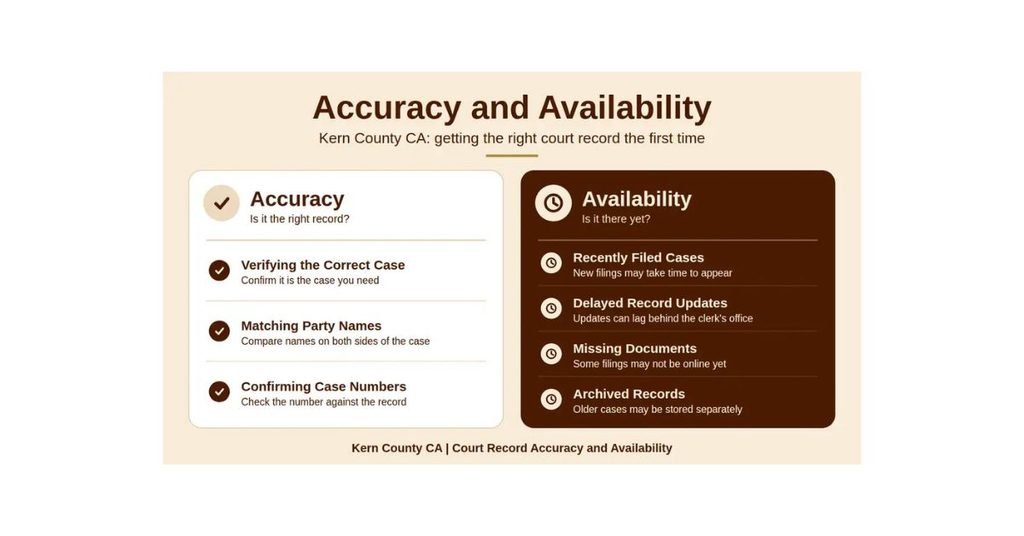
Court records are only useful when they are accurate and up to date. The Kern County clerk’s office updates the system throughout the day, but a few delays and gaps can show up depending on the case type and age. Knowing how to spot and fix these issues saves you time and helps you get the right record on the first try.
Verifying the Correct Case
Always verify that the case number, party name, and filing date on the summary match the case you are looking for. A single digit error in the case number can pull up a different case, so check the full number against any paperwork you already have. The case type field is another good check, since it should match the legal category of the matter.
Matching Party Names
Party names can be entered in different ways depending on how they were typed at filing. Watch for middle initials, suffix changes (Jr., Sr., III), and name changes after marriage or court order. Searching by last name with a date of birth can help you confirm you have the right person when several cases share the same name.
Confirming Case Numbers
Confirm the case number by reading it off a court document, legal filing, or notice you already received. If you do not have a document, run a name search first and write down the case number from the matching result. This step keeps you from typing a wrong number into a future search or certified copy request.
Recently Filed Cases
Cases filed in the last few days may not show up in the portal right away, since the clerk needs time to scan and index the first documents. A 24 to 72 hour delay is common for brand new filings. If the case is brand new, wait one business day and try the search again before calling the clerk’s office.
Delayed Record Updates
Some updates, like hearing outcomes and minute orders, take a few days to scan and post on the portal. Old archived cases may be slower still, since the clerk needs to pull the physical file. Always check the “last updated” date on the case summary to see when the data was last refreshed.
Missing Documents
Missing documents happen when a filing was made on paper and is still waiting to be scanned, or when the document was sealed by a judge. If the docket lists a document you cannot view, contact the clerk’s office to ask about the status. They can confirm whether the document exists and is still being processed.
Archived Records
Archived records are cases that have been closed for many years and moved to off-site storage. The clerk may need extra time to retrieve these files, especially for older boxes of paper records. Plan for a longer wait when requesting certified copies from cases closed more than 10 years ago.
Court Records Search Problems
Search problems are common, and most of them have simple fixes once you know what to look for. The list below covers the most frequent issues people run into when searching Kern County court records and what you can do to solve them. You can also reach the clerk’s office for help if the problem continues after you try the steps below.
Case Not Found
A “case not found” message usually means the case number has a typo, the case was filed in another county, or the case is too new to appear online. Double-check the case number, remove any dashes, and try the search again. If the case still does not show up, call the clerk’s office to confirm the county and filing year.
Incorrect Party Name
Spelling errors, missing middle names, and name changes can all lead to a wrong or empty search result. Try a broader search with just the last name, and then narrow down by looking at the filing date and case type. Searching by date of birth or address can help when common names bring up many results.
Incorrect Case Number
One wrong digit in a case number will return no results or the wrong case. Always re-read the number out loud or copy it from the original document to avoid typos. If you do not have the original document, run a name search first and write down the case number from the correct match.
Wrong Court or Jurisdiction
Cases filed in other California counties will not show up on the Kern County portal. If your case was filed in a different county, you need to visit that county’s Superior Court website to search. Federal cases, like those in the U.S. District Court, are also kept on a separate system called PACER.
Missing Documents
Missing documents can occur when a filing has not been scanned yet, when the file is in off-site storage, or when a judge sealed the document. The docket will still list the document, even if the image is not available. Contact the clerk’s office to ask when the document will be ready for viewing.
Restricted or Sealed Records
Restricted or sealed records do not show up in public searches at all. You will only see a basic entry with limited details, and the documents are hidden. To view a sealed record, you must file a motion with the court and get a judge’s order granting access.
Outdated Case Information
Outdated case data can show up on the portal when a recent ruling or order has not been scanned yet. Check the last updated date on the case summary to see how fresh the data is. For a real-time answer on the case status, call the clerk’s office during business hours.
Contact Details
You can reach the Kern County Superior Court clerk’s office at the main courthouse in Bakersfield during regular business hours. The clerk’s office can help with case searches, certified copies, and questions about how to access sealed or archived files. Use the contact details below to call, visit, or plan your records request.
- Physical Address: 1415 Truxtun Avenue, Bakersfield, CA 93301
- Phone: (661) 610-6000
- General Hours: Monday through Friday, 8:00 a.m. to 4:00 p.m.
Frequently Asked Questions
Finding court records in Kern County helps you verify legal matters, settle disputes, and gather reliable data for personal or business decisions. The online portal connects directly to the Superior Court of California, County of Kern, letting you view civil, criminal, family, probate, and juvenile filings. Access is free for most public documents, and you can search by name, case number, filing date, or case type. Quick access saves time and reduces the need for in‑person visits to the clerk’s office at 1415 Truxtun Avenue, Bakersfield.
How can I search Kern County court records online?
Visit the official case information search page. Choose the court type, then enter a party name, case number, filing date, or case type. Click Search to view a list of matching files. Select a case to see docket entries, motions, orders, and related documents. The site updates daily, so recent filings appear quickly. If a record does not show, verify spelling or try a broader date range.
What information is included in a Kern County court case record?
A case record shows the case number, filing date, parties involved, and the court handling the matter. It lists each filing such as complaints, motions, orders, and judgments. Status updates indicate whether the case is active, closed, or dismissed. For criminal cases you will see charges and disposition. Family and probate files include custody or inheritance details where public.
Can I request certified copies of Kern County court documents?
Yes. Call the clerk’s office at (661) 610‑6000 during business hours to place a request. Provide the case number and specify the documents you need. Fees range from $5 to $15 per page. Expect a processing time of 3‑5 business days for standard requests. Certified copies carry the court seal and are accepted by most agencies.
How do I find a Kern County case by party name?
Start at the online search portal and select “Party Name” as the search field. Type the full or partial name, then choose the appropriate court (e.g., Superior, Juvenile). The system returns all cases that match the name, allowing you to filter by date or case type. Review each result to locate the exact filing you need. If multiple matches appear, refine the search with additional details such as filing year.
What steps should I take if a Kern County court record is missing?
First, double‑check the spelling and try alternative name formats. Next, broaden the date range or remove case‑type filters. If the record still does not appear, contact the clerk’s office for assistance. Provide the case number or party details; staff can confirm whether the file is archived or restricted. For sealed or restricted records, you may need a court order or attorney’s request to access the information.